Positive behaviour support (PBS) in schools is an evidence-based approach that helps teachers understand why behaviours of concern happen, and respond by meeting the child’s underlying need rather than relying on sanctions alone. It works in three tiers. Everyday universal strategies in the classroom meet the needs of most pupils, and targeted and specialist support is there for those who need more.
Key takeaways
Behaviours of concern are communication. They tell us a need isn’t being met.
Early warning signs, including distress at home, can show unmet needs before behaviour escalates.
Around 80% of pupils are well supported by good universal classroom strategies.
Every behaviour has a function, often summed up as SEAT: sensory, escape, attention (connection) or tangible.
Thinking in terms of ABC (Antecedent, Behaviour, Consequence) helps you find the need behind a behaviour.
Recently, I met with a primary school teacher as part of an assessment for a child with a learning disability and significant additional needs. At home, the child’s behaviours of concern were causing the family real distress, every day.
At school, the picture was different. The teacher told me there were five other children in her class who worried her more, and none of them had an EHCP, additional needs funding or any identified support needs.
She had been teaching primary school children for ten years. She had trained as a teacher, but responding to behaviour had never been a meaningful part of that training, and it now took up far more of her day than when she started.
Our conversation turned to what those five children might be experiencing: their inner emotional worlds, and what their behaviour might be trying to tell her. This is the question that sits at the heart of positive behaviour support.
Why we need to look beyond the behaviour
Behaviour is loud, visible and hard to ignore, so it naturally becomes the focus. But behaviours of concern are rarely the real problem. They are a signal that something isn’t right, and usually that several needs are going unmet.
If we respond only to what we can see, we may stop a behaviour for a moment, but the need underneath is still there and it will find another way to be heard. This is what we mean by behaviour as communication.
How to recognise when a pupil’s needs aren’t being met
Behaviours of concern rarely come out of nowhere. There are usually earlier, quieter signs that a pupil is struggling:
Increased fidgeting, rocking or getting up from their seat.
Avoiding tasks, frequent requests to go to the toilet, or asking to leave the room.
Becoming withdrawn, quiet or “switched off”.
Difficulties at the same times each day, such as after lunch, at transitions or during unstructured time.
Reports from home of distress after school, even when the pupil seems settled in class.
That last sign matters. Some neurodivergent pupils, particularly autistic pupils, work very hard to hold things together at school, sometimes called masking, and then release that stress once they’re home. A pupil who seems fine in class may still have significant unmet needs. It can also help explain why a pupil’s behaviour at home and at school can look so different. When school and home share what they’re each seeing, the full picture becomes much clearer.
So how do we find out what those unmet needs are?
What is positive behaviour support?
Positive Behaviour Support is a values-led, evidence-based framework. It aims to improve a young person’s quality of life, understand what their behaviour is communicating, and change the environment around them so the behaviour becomes less necessary.
In schools, PBS sits comfortably alongside SEMH provision and the “ordinarily available” support most local authorities expect mainstream settings to offer. It also aims to reduce reliance on sanctions, exclusions and restrictive practices.
The three tiers of PBS in schools
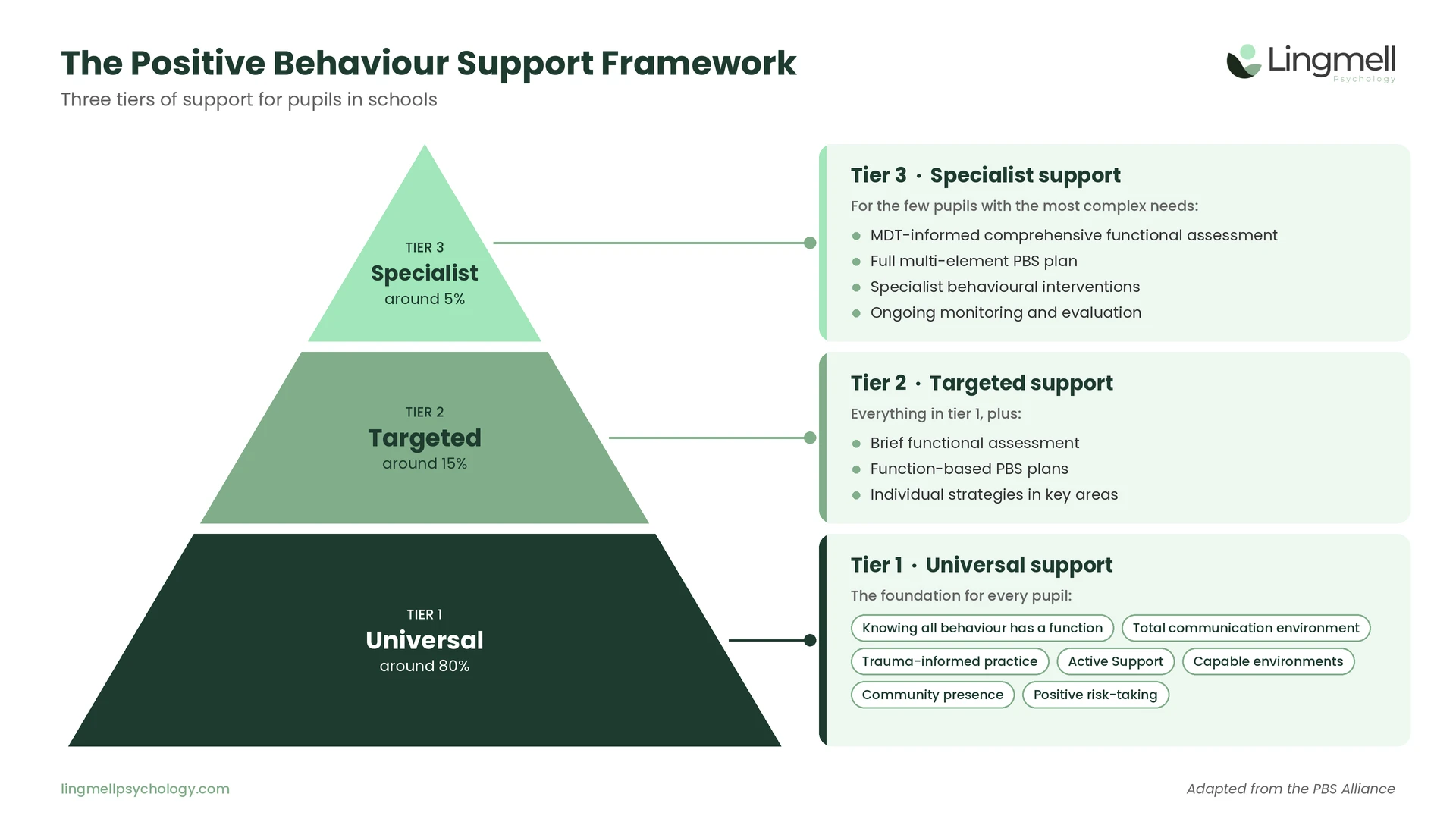
PBS is usually shown as a pyramid with three tiers. The percentages are rough guides, not fixed rules:
Universal support (around 80% of pupils). Whole-class approaches that meet most children’s needs, most of the time.
Targeted support (around 15%). Extra strategies for pupils whose needs aren’t fully met by universal approaches.
Specialist support (around 5%). Intensive, individualised support for children with the most complex needs.
The PBS Alliance has created a helpful version of this pyramid to promote the wider use of PBS. In this guide we focus on its universal tier (tier 1), picking out the parts most relevant to mainstream classrooms, because every teacher and teaching assistant can use these strategies today.
The three tiers of positive behaviour support in schools, adapted from the PBS Alliance.
Knowing that all behaviour has a function
A core principle of PBS is that all behaviour has a function. Everything we do is meaningful and purposeful; nothing is done for its own sake.
Behaviours of concern don’t feel good for the child doing them. If a child keeps using a behaviour despite the trouble it causes them, that tells us how much they need what it achieves.
One helpful way to think about it is that a behaviour of concern is a child saying: “This environment isn’t working for me, and I don’t have the skills or the authority to make it better.”
When the environment isn’t working, stress hormones such as adrenaline rise, and a child’s capacity to wait, think or problem-solve shrinks. That is often the moment a behaviour of concern appears.
If the behaviour then leads to a change that meets the need, it is reinforced, and it becomes more likely to happen the next time that need comes up.
The four functions of behaviour (SEAT)
Behaviour is commonly thought of as serving one of four functions, often remembered with the acronym SEAT:
Sensory: meeting a sensory need, such as getting movement or pressure the body is seeking, or blocking out noise, light or touch that feels overwhelming.
Escape: getting away from a task, environment or situation that feels too difficult, uncomfortable or stressful.
Attention: seeking connection, reassurance or interaction with adults or peers. This is a real need, not a character flaw; we often find it more helpful to think of it as connection-seeking.
Tangible: getting access to a specific thing, such as a toy, food or a favourite activity.
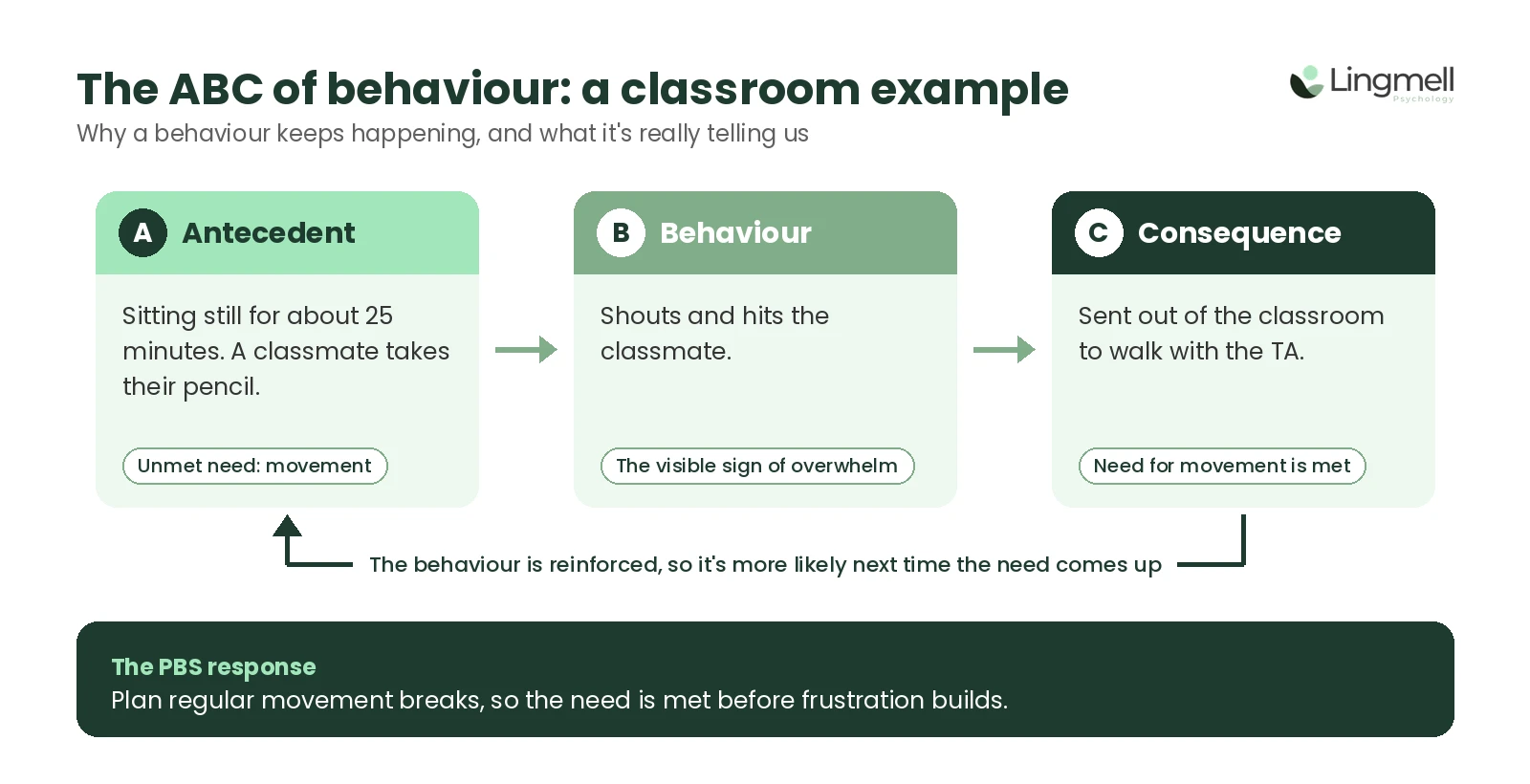
A single behaviour can serve more than one function. In the example below, hitting out met a sensory need for movement and an escape need to leave the classroom, which is part of why it was so likely to happen again.
Understanding behaviour with ABC
A: Antecedent. What happened before the behaviour? This is often the need, or the thing that went wrong.
B: Behaviour. What the child did. This is usually the part that’s easiest to see.
C: Consequence. What happened immediately afterwards.
A worked example
A pupil has been sitting still at their desk for a long time. They’ve reached the limit of their capacity to stay still, but they know they’re not allowed to get up, so they’re putting all their effort into staying in their seat.
With so much energy going into sitting still, they have very little left for anything else. When a classmate takes their pencil, they lash out and hit them. This isn’t only about the pencil. It happens because their sensory need for movement hasn’t been met.
The pupil is sent out of the classroom. Without anyone intending it, that meets their need for movement and a change of scene. The behaviour has been reinforced.
The ABC of behaviour: why a behaviour keeps happening, and what it is really telling us.
Laid out like this, the main problem isn’t the hitting. It’s the pupil’s need to move, which conflicts with the classroom’s need for them to stay still.
So the question changes from “How do we stop this unpredictable hitting?” to “How do we build regular movement breaks into this pupil’s day?” That shift, from reacting to preventing, is what PBS makes possible.
Free ABC chart template for teachers
To help you get started, we’ve created a free, printable ABC chart template designed for mainstream classrooms. It turns everyday observations into information you can actually use.
Get your free ABC chart (PDF)
Enter your details below and the chart will open straight away.
We’ll use your details to send you the chart and occasional updates from Lingmell Psychology. You can unsubscribe at any time. See our privacy policy.
What’s included
A recording sheet with columns for the setting, setting events (such as poor sleep, hunger or a change to routine), and the antecedent, behaviour and consequence, plus a completed example row to show you how it works.
SEAT function boxes to tick when you review the chart, based on the four functions of behaviour.
A review page with questions to help you spot patterns, record what’s already working, and agree next steps as a team.
How to use the ABC chart
Choose one or two behaviours to focus on. Describe them in observable terms. “Runs to the door” is more useful than “defiant”, because everyone can agree on what they saw.
Decide when you’ll record. You don’t need to record all day. If the behaviour tends to happen in particular lessons or at particular times, start there.
Involve your team. If you work with a teaching assistant, share the chart so you can both record, and compare what you each notice.
Record as soon as you can. Keep the chart somewhere handy and note what you saw and heard, not what you think the pupil was feeling or intending. Leave the function boxes until your review.
Look for patterns. After at least a week, or longer if the behaviour is less frequent, use page 2 to look at what tends to happen before and after, and what need the behaviour might be meeting.
Share with home. Where possible, talk the chart through with the family. What happens after school is often part of the picture.
If patterns are hard to see, or behaviours of concern continue despite changes in the classroom, a functional behaviour assessment may help.
Worried about a pupil in your class? Our clinical psychologists carry out functional behaviour assessments and create PBS plans that connect home and school. Book a free 15-minute consultation.
Four PBS strategies for behaviours of concern in the classroom
1. Create a total communication environment
A total communication environment uses every available way of communicating to support understanding and expression. That includes speech, facial expression, gesture, body language, visual supports, signs, symbols, written words, objects of reference and assistive technology. Rather than relying on speech alone, information is shared in several ways, and each pupil can communicate in the way that works best for them.
This matters because communication difficulties are common in mainstream classrooms. They affect many pupils with autism, ADHD, developmental language disorder, learning disabilities, hearing impairments and social communication needs. NICE guidance recognises that people with a learning disability who also have communication difficulties may be more likely to develop behaviour that challenges. When a pupil can’t understand, or can’t make themselves understood, frustration builds.
In the classroom: Pair a spoken instruction with a gesture and a written or visual prompt on the board. Use a “now and next” board for pupils who struggle with transitions. Give every pupil a quick non-verbal way to say “I need help” or “I need a break”, such as a card on their desk.
2. Use Active Support
Active Support is an evidence-based approach that helps people take part as fully as possible in meaningful activities. Rather than doing things for a pupil, adults give just enough support for them to take part and succeed, and step back gradually as their independence grows.
Ways to build Active Support into lessons:
Adapt tasks so that every pupil can experience success.
Break instructions into smaller steps and support one step at a time.
Use visuals, checklists and demonstrations alongside spoken instructions.
Offer choices throughout lessons to increase motivation.
Give prompts (verbal, visual or gestural) and fade them as skills develop.
Share out classroom jobs, such as handing out resources or leading an activity.
Celebrate effort and engagement, not just finished work.
Build in opportunities for peer support and collaborative learning.
In the classroom: Instead of a teaching assistant scribing for a pupil, the TA writes the first word, the pupil writes the next, and the TA’s share gets smaller each week. The pupil stays actively involved rather than watching someone else do the work.
3. Build a capable environment
A capable environment is deliberately designed to help pupils succeed. Rather than expecting pupils to fit the classroom, the classroom is adapted to fit the pupils, with clear routines, visual supports, accessible resources and real choice. Many of these changes are simple reasonable adjustments that cost little but make a big difference.
Choice is one of the most powerful tools here. Pupils can choose where they sit, which materials they use, how they show their learning, or the order in which they complete tasks. For pupils with communication difficulties, choices can be offered with pictures, symbols or objects. Having some control over their day builds motivation, confidence and self-determination.
In the classroom: For the pupil in our worked example, a capable environment might include a planned “movement job” every 20 minutes, such as taking the register to the office or handing out books. It meets the need for movement before frustration builds.
4. Use trauma-informed practice
Trauma-informed practice recognises that some children have experienced adversity, loss, neglect, abuse, family instability or other highly stressful events, and that these experiences shape behaviour, learning and relationships. Instead of asking “What’s wrong with this child?”, it asks “What might have happened to this child, and how can we help?”
Trauma can affect concentration, emotional regulation, trust and coping with change. Some children become withdrawn; others appear angry or oppositional. These responses are often adaptive: ways of staying safe that made sense in the child’s earlier experiences. They are not deliberate choices to be difficult.
A trauma-informed classroom prioritises safety, predictability and connection. Useful approaches include consistent routines, calm communication, visual timetables, warning pupils about changes ahead of time, teaching emotional regulation skills, and making sure each child has a trusted adult. These approaches benefit every pupil, not just those who have experienced trauma.
How to respond to behaviours of concern in the moment
Prevention is the heart of PBS, but behaviours of concern will still sometimes happen. When they do, a few principles help:
Stay as calm as you can. A dysregulated child needs a regulated adult nearby. This is co-regulation: a calm adult helps a pupil’s nervous system settle, which is the foundation of effective de-escalation.
Use fewer words. Keep your language short, simple and quiet.
Reduce demands. This isn’t the moment to insist on finishing the task.
Make space and keep everyone safe, including the pupil themselves.
Reconnect and repair afterwards. Once everyone is calm, reflect together on what happened and what might help next time.
For pupils whose behaviours of concern put themselves or others at risk, an individual PBS plan should set out agreed reactive strategies that everyone follows consistently.
How to use positive behaviour support in the classroom: 6 steps
If you’re wondering how schools can support children with autism and learning disabilities day to day, these six steps are a good place to start.
Look beyond the behaviour to the need it is communicating.
Think in ABC to notice what happens before and after a behaviour.
Communicate in many ways, not just through speech.
Support participation rather than doing things for pupils.
Adapt the environment, using routines, visuals and real choice.
Lead with curiosity, safety and connection.
These universal strategies sit naturally alongside the graduated “assess, plan, do, review” approach in the SEND Code of Practice. They give teachers a practical way to act on it day to day.
None of this depends on a diagnosis or an EHCP. As the teacher I met reminded me, many of the pupils who most need this understanding have no identified support needs at all.
When a pupil needs more: functional behaviour assessment
For pupils in the targeted and specialist tiers, working with a clinical psychologist can make a real difference.
A functional behaviour assessment (FBA) uses observation, interviews and records to understand what a behaviour does for a young person. The psychologist gathers information from the people who know them best: parents, carers, teachers, support staff and, wherever possible, the young person themselves. ABC analysis is a central part of this.
The assessment leads to a positive behaviour support plan. The plan sets out proactive strategies to prevent behaviours of concern, reactive strategies for when they happen, and skills to teach. Home and school then work in the same direction.
How Lingmell Psychology can help
Like walking up a mountain, there are many paths depending on where a child begins, and it helps to have a map and someone alongside you.
For schools, SENCos and school leaders: we deliver PBS training for schools in Bristol and online across the UK. Our whole-staff sessions and consultation help teachers and TAs understand behaviours of concern and feel confident using positive behaviour support in the classroom.
For individual pupils and families: our clinical psychologists carry out functional behaviour assessments and create PBS plans that join up home and school. We see families face to face in Bristol, and work online with families and schools across the UK.
Positive behaviour support (PBS) is an evidence-based approach that helps schools understand why behaviours of concern happen and respond by meeting the child’s underlying needs. It focuses on proactive changes to the environment rather than punishment.
What are the three tiers of positive behaviour support?
PBS has three tiers: universal support for all pupils (around 80%), targeted support for pupils who need more (around 15%), and specialist, individualised support for pupils with the most complex needs (around 5%).
What is a behaviour of concern?
A behaviour of concern is any behaviour that puts a young person or others at risk, or limits their learning, relationships or quality of life. Examples include hitting, running away, self-injury or shutting down. The term is often used instead of “challenging behaviour” because it focuses on the concern, not on labelling the child.
What does “all behaviour has a function” mean?
It means every behaviour serves a purpose for the person doing it. Behaviours of concern are often a child’s way of communicating that something in their environment isn’t working and that they have no other way to change it.
What are the four functions of behaviour?
The four functions of behaviour are often remembered as SEAT: Sensory (meeting a sensory need), Escape (getting away from something difficult), Attention (seeking connection with others) and Tangible (getting access to a specific item or activity). A behaviour can serve more than one function at once.
What is an ABC analysis?
ABC stands for Antecedent, Behaviour and Consequence. It records what happens before a behaviour, the behaviour itself, and what happens immediately afterwards, to help identify what triggers or maintains it.
How long should you use an ABC chart for?
Record for at least a week, or longer if the behaviour happens less often. You need enough examples to see patterns in what tends to happen before and after the behaviour.
How is PBS different from traditional behaviour management?
Traditional behaviour management usually focuses on rewards and sanctions to change what a child does. PBS focuses on understanding why the behaviour happens and changing the environment and teaching skills so the child’s needs are met, which makes the behaviour less necessary.
When does a child need a functional behaviour assessment?
A functional behaviour assessment may help when behaviours of concern continue despite good universal strategies, or when they significantly affect a child’s wellbeing, learning or family life. A clinical psychologist can carry out the assessment and create a PBS plan for home and school.
Does a child need an EHCP or a diagnosis to benefit from PBS?
No. Universal PBS strategies benefit all pupils, and many children with behaviours of concern have no formal diagnosis or EHCP.
Do you offer PBS training for schools in Bristol?
Yes. Lingmell Psychology offers positive behaviour support training and consultation for schools in Bristol, delivered in person, and online for schools across the UK. Sessions can be tailored for whole staff teams, SENCos or teaching assistants.
Get In touch with us
We offer a free 15-minute initial consultation to help you decide what feels like the right next step for you.
There’s no pressure and no obligation – just a confidential, supportive conversation with an experienced professional.
To provide the best experiences, we use technologies like cookies to store and/or access device information. Consenting to these technologies will allow us to process data such as browsing behaviour or unique IDs on this site. Not consenting or withdrawing consent, may adversely affect certain features and functions.
Functional
Always active
The technical storage or access is strictly necessary for the legitimate purpose of enabling the use of a specific service explicitly requested by the subscriber or user, or for the sole purpose of carrying out the transmission of a communication over an electronic communications network.
Preferences
The technical storage or access is necessary for the legitimate purpose of storing preferences that are not requested by the subscriber or user.
Statistics
The technical storage or access that is used exclusively for statistical purposes.The technical storage or access that is used exclusively for anonymous statistical purposes. Without a subpoena, voluntary compliance on the part of your Internet Service Provider, or additional records from a third party, information stored or retrieved for this purpose alone cannot usually be used to identify you.
Marketing
The technical storage or access is required to create user profiles to send advertising, or to track the user on a website or across several websites for similar marketing purposes.