


You snap at someone you love over something small. You get home after a long day and can’t do anything except scroll. You lie awake replaying a conversation, or feel strangely flat around people and things you used to enjoy. Maybe you’ve started to wonder: why does my body react like this?
The answer often lies in your nervous system. Many people now describe this as nervous system dysregulation. It isn’t a sign that something is wrong with you. It’s your body doing exactly what it learned to do to keep you safe.
These patterns are easy to miss, especially if you’re busy looking after everyone else, holding down a demanding job or simply getting through. This guide explores what your nervous system is trying to do, what regulation and dysregulation mean, the signs your body may still be in survival mode, and the gentle steps that can help you find your way back to feeling steady.
What Is Nervous System Dysregulation?
Nervous system dysregulation is when your body’s stress response stays stuck in survival mode, reacting with too much (anxiety, panic, irritability) or too little (numbness, shutdown) for the situation you’re in.
To understand why this happens, it helps to start with what your nervous system is for.
Your Nervous System Is There to Keep You Safe
Your nervous system’s main job is to keep you safe. Every moment of every day, it scans your surroundings, your body and your relationships for signs of safety or danger. It does this mostly below conscious awareness, faster than thought.
Therapist and author Deb Dana calls this process a kind of constant listening. Your body is always asking: am I safe here? Am I safe with these people?
It works incredibly hard. It responds to deadlines, difficult conversations, noisy rooms, poor sleep, painful memories and the needs of the people around you. Often, it’s doing all of this while you’re busy somewhere else, in your head, getting through the to-do list.
Many of us have learned to live disconnected from our body’s messages. We override tiredness, ignore tension and push through. This mind–body split can mean we don’t notice our nervous system is struggling until it’s shouting at us.
What a Balanced Nervous System Looks Like
When your nervous system is in balance, it doesn’t mean you feel calm all the time. Life still brings stress, frustration and sadness. The difference is in how your body responds and recovers.
When you’re feeling balanced, you might notice that you can:
- Assess safety and respond proportionately. A tricky email feels annoying, not like an emergency.
- Think and reflect. You can pause, weigh up options and make choices in line with your values.
- Return to feeling connected. After a stressful moment, you come back to yourself fairly quickly. You can laugh, rest and feel close to others again.
This flexibility is the heart of a healthy nervous system. It isn’t about never being activated. It’s about being able to move in and out of activation, and find your way back.
Regulation vs Dysregulation: When Reactions Are Too Big or Too Small
Regulation and dysregulation are words we use to describe how your body responds to threat and adjusts to keep you safe.
Nervous system regulation means your body can adjust and respond to what’s happening. It rises to meet a challenge, then settles once the challenge has passed.
Nervous system dysregulation means your reactions are either too big or too small for the situation in front of you. You might flood with panic over something minor. Or you might go numb and switch off when something really does need your attention.
It’s important to say that these responses usually make sense. Often, they’re learned survival responses that kept you safe at an earlier point in your life. Perhaps staying on high alert helped you predict an unpredictable home. Perhaps shutting down helped you get through something you couldn’t escape. These strategies worked. The difficulty comes when they generalise to all situations and become stuck. A response that once protected you can start to show up at work, in your relationships and in moments where you are, in fact, safe.
Why Some of Us Are More Affected
Everyone’s nervous system gets pushed out of balance sometimes. But some things make it more likely to get stuck there:
- Past experiences. Growing up in an unpredictable or unsafe environment, or living through trauma, can teach your body to stay on guard.
- Long-term stress. Money worries, health problems, a demanding job, caring for a relative or juggling too much with too little support.
- Little time to recover. When one hard moment follows another, your body never gets the chance to settle.
- A culture of coping. Many of us were taught to keep calm and carry on, so the signs of dysregulation get dismissed as “just how life is”.
People in caring and supporting roles, such as parents, carers, nurses, teachers and therapists, often carry an extra load. They spend their days holding other people’s distress and lending others their steadiness, which leaves less for themselves. Over time, this can build into vicarious trauma.
None of this means you’re weak or failing. It means your body is responding to real demands, and you deserve support too.
Signs Your Body Is Still in Survival Mode
When your nervous system is dysregulated, it tends to move into one of two broad states. You might recognise yourself in one, or swing between both.
High Alert (Fight or Flight)
This is a state of hyperarousal, where your body is mobilised for danger. You might notice:
- Feeling on edge, irritable or quick to snap, even over small things
- A racing heart, shallow breathing, tight shoulders or a clenched jaw
- Struggling to switch off, with racing thoughts at night
- Constantly scanning for what might go wrong
- Feeling that you have to stay busy, because slowing down feels unsafe
In everyday life, this might look like: rereading a message five times before sending it. A jolt of dread when your phone rings. Never taking a proper lunch break. Or reacting sharply to your partner and wondering afterwards where that came from.
Numbed Out (Freeze or Shutdown)
This is a state of hypoarousal, where your body conserves energy by shutting down. You might notice:
- Feeling flat, foggy, disconnected or “not really here”
- Low energy and motivation, even for things you used to enjoy
- Struggling to concentrate or make decisions
- Withdrawing from people or going quiet in conversations
- Feeling numb rather than sad
In everyday life, this might look like: going blank when someone asks how you really are. Feeling distant from friends you used to feel close to. Putting off simple tasks for days. Or getting home with nothing left to give.
Functional Freeze: Getting Through the Day on Autopilot
Some people don’t look shut down at all. They go to work, answer emails, run the household and look after everyone else, but inside they feel numb, foggy and running on empty. This is sometimes called functional freeze: your body keeps you going on the outside while the freeze response carries on underneath. It’s especially common in people whose lives leave little room to stop.
Physical Symptoms of Nervous System Dysregulation
Because survival responses live in the body, dysregulation often shows up physically first. You might notice:
- Muscle tension, a clenched jaw or tension headaches
- Shallow breathing or a racing heart
- Disrupted sleep, or waking up already tired
- Digestive changes, such as a churning stomach or loss of appetite
- Being easily startled, or sensitive to noise and busy places
- Exhaustion that rest doesn’t fix
These symptoms can have many causes, so it’s always worth speaking to your GP to rule out a physical health condition.
Both states take an enormous amount of energy. Living on high alert is exhausting. So, in a different way, is shutdown, because your body is still braced, just underneath the surface. That’s why many people in survival mode feel tired all the time, however much they rest. If this feels familiar in a work context, our guide to vicarious trauma vs burnout explores how the emotional load of supporting others can add to it.
The Window of Tolerance
A helpful way to picture all of this is the window of tolerance, a model first described by psychiatrist Dr Dan Siegel. Imagine a zone in the middle where you can think, feel and connect. Inside your window, you can handle stress without being overwhelmed by it.
Above the window is hyperarousal: anxiety, anger, panic, overwhelm. Below it is hypoarousal: numbness, shutdown, disconnection. Stressful experiences, and especially trauma, can narrow the window. It then takes less to tip you out of it.
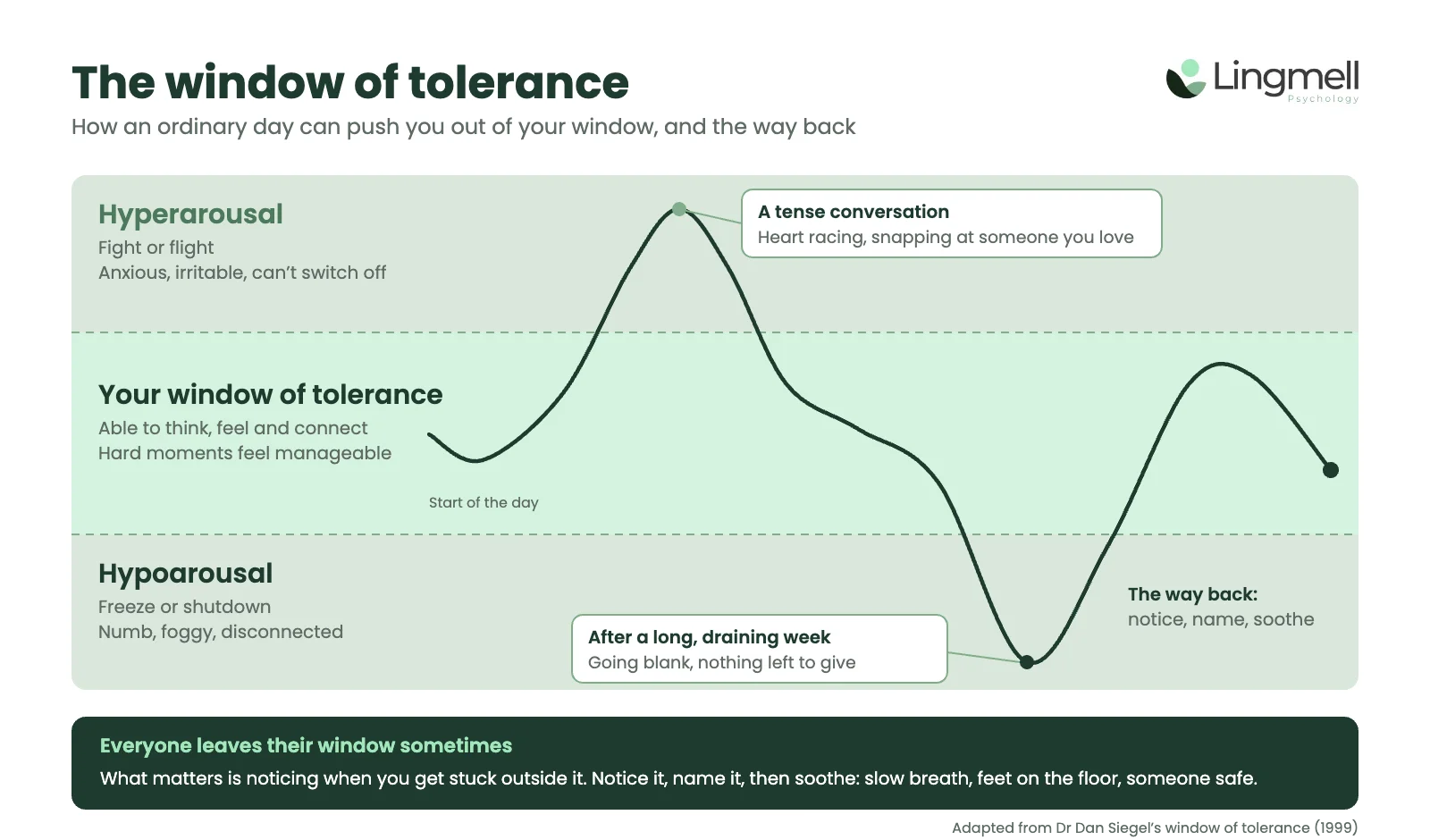
It’s normal to move outside your window of tolerance sometimes. Everyone does. A shock, a loss or a hard day can push any of us out. What we want to take notice of is when you get stuck outside it. That’s when your body stays in survival mode long after the danger has passed.
Recognise yourself in this? You don’t have to work it out alone. Our clinical psychologists in Bristol offer trauma-focused therapy for adults, in person and online, starting with helping your nervous system feel safer. Book a free 15-minute call.
What Can Help a Dysregulated Nervous System
Your nervous system can learn new patterns. Regulation isn’t something you have to force. It grows gently, over time, and usually in relationship with others. Here are three places to begin.
Observe With Compassion
The first step is simply noticing. When you can observe what’s happening in your body and name it, you create a little distance from it. “I’m noticing my chest is tight and my thoughts are racing. I think I’m on high alert.”
That small act of noticing can help you “unbend” from the reaction. Instead of being swept along by it, you have a moment to choose what you do next. The key is to notice with kindness, not judgement. Telling yourself off adds more threat to a system that already feels unsafe.
Make Links Between What Happened and What You Needed to Do
Many people come to therapy asking “what’s wrong with me?” A more helpful question is: “what has happened to me, and what did my mind and body have to do to survive it?”
This shift is at the centre of the Power Threat Meaning Framework, published by the British Psychological Society’s Division of Clinical Psychology. Instead of seeing distress as a set of symptoms, it invites us to understand our reactions as meaningful responses to threat.
The part of you that stays on high alert, the part that people-pleases, the part that shuts down: each learned its role for a reason. Getting to know these parts with curiosity, rather than trying to get rid of them, can soften the shame that so often comes with them. It can also help you notice which patterns no longer fit the life you’re living now.
Build Relationships, Practices and Places Where You Feel Safe
Our nervous systems are shaped in relationship, and they heal in relationship too. Feeling safe with others is one of the most powerful regulators we have.
Compassion Focused Therapy, developed by Professor Paul Gilbert, describes three emotion regulation systems, often drawn as three circles:
- The threat system, which keeps us alert to danger
- The drive system, which motivates us to achieve and get things done
- The soothing system, which helps us feel safe, content and connected
In survival mode, the threat and drive systems often take over and the soothing system gets very little use. Part of regulation is deliberately strengthening that third circle. This could mean time with people who feel safe, being in nature, music, movement, rest, or a regular moment of kindness towards yourself. The Self-Compassion Institute has a range of free, guided practices that are a gentle place to start.
When to Seek Support
Self-awareness and soothing practices can make a real difference. But if you’ve been stuck in survival mode for a long time, or your responses are linked to difficult past experiences, it can be hard to shift on your own. This isn’t a failing. Patterns that formed in relationship often need a safe relationship to change.
You might consider extra support if:
- You feel on edge or numb most of the time, not just after stressful events
- Your reactions are affecting your relationships, work or health
- You find yourself avoiding people, places or situations that remind you of the past
- Self-help strategies help briefly, but you keep returning to the same place
If any of these sound familiar, a free 15-minute call can be a gentle first step. There’s no pressure to commit to anything.
If you supervise or manage others, our guides to trauma-informed supervision and when to refer a supervisee for therapy look at how to recognise these patterns in your team, and how to respond.
How Lingmell Can Help
At Lingmell Psychology, our HCPC-registered Clinical Psychologists offer therapy for adults in caregiving and support roles, in Bristol and online. Our work is trauma-focused and phased. We begin by helping your nervous system feel safer and more resourced. Then we move towards understanding your story and the survival patterns that developed along the way.
We draw on Internal Family Systems, Compassion Focused Therapy and Eco-Psychology, and we always adapt to your needs, your capacity and what matters to you. You can read more about our approach, or explore our free resources.
Frequently Asked Questions
What causes nervous system dysregulation?
It often develops after experiences that felt overwhelming or unsafe. That includes trauma, but also long-term stress, unpredictable environments or relationships where you had to stay on guard. Over time, those survival responses can become your body’s default setting, even when you’re safe.
What are the signs of a dysregulated nervous system?
Common signs include feeling constantly on edge, irritable or anxious, or feeling numb, foggy and disconnected. Many people swing between the two. Physical signs include tension, poor sleep, a racing heart and exhaustion that doesn’t lift with rest.
Is nervous system dysregulation the same as anxiety?
Not quite. Anxiety is one way dysregulation can show up, when your body is stuck on high alert. But dysregulation also includes shutdown, numbness and exhaustion, which don’t always feel like anxiety. Anxiety disorders are diagnosable conditions; dysregulation is a way of understanding what your body is doing. The two often overlap.
How do I know if I’m stuck in survival mode?
You may be stuck if high alert or shutdown has become your usual state rather than a passing reaction. Another sign is if your responses feel out of proportion to what’s happening, or are affecting your work, relationships or health.
How do you treat a dysregulated nervous system?
Noticing your responses with compassion, understanding where they came from and spending time in safe, soothing relationships and places all help. For longstanding patterns, especially those linked to trauma, therapy offers a safe relationship in which that change can happen.
How long does it take to regulate your nervous system?
In the moment, a few slow breaths or grounding through your senses can help you settle within minutes. Changing patterns that have been in place for years takes longer, and it looks different for everyone. Progress is usually gradual: your window of tolerance widens, and you recover more quickly when you’re pushed out of it.
Ready to Feel Safer in Your Own Body?
Whether you’re on high alert, numbed out or moving between the two, supporting others shouldn’t mean losing connection with yourself. We’d be glad to talk it through with you.
Book a free, no-obligation call with Lingmell Psychology to explore what’s happening for you and whether trauma-focused therapy feels like the right next step.